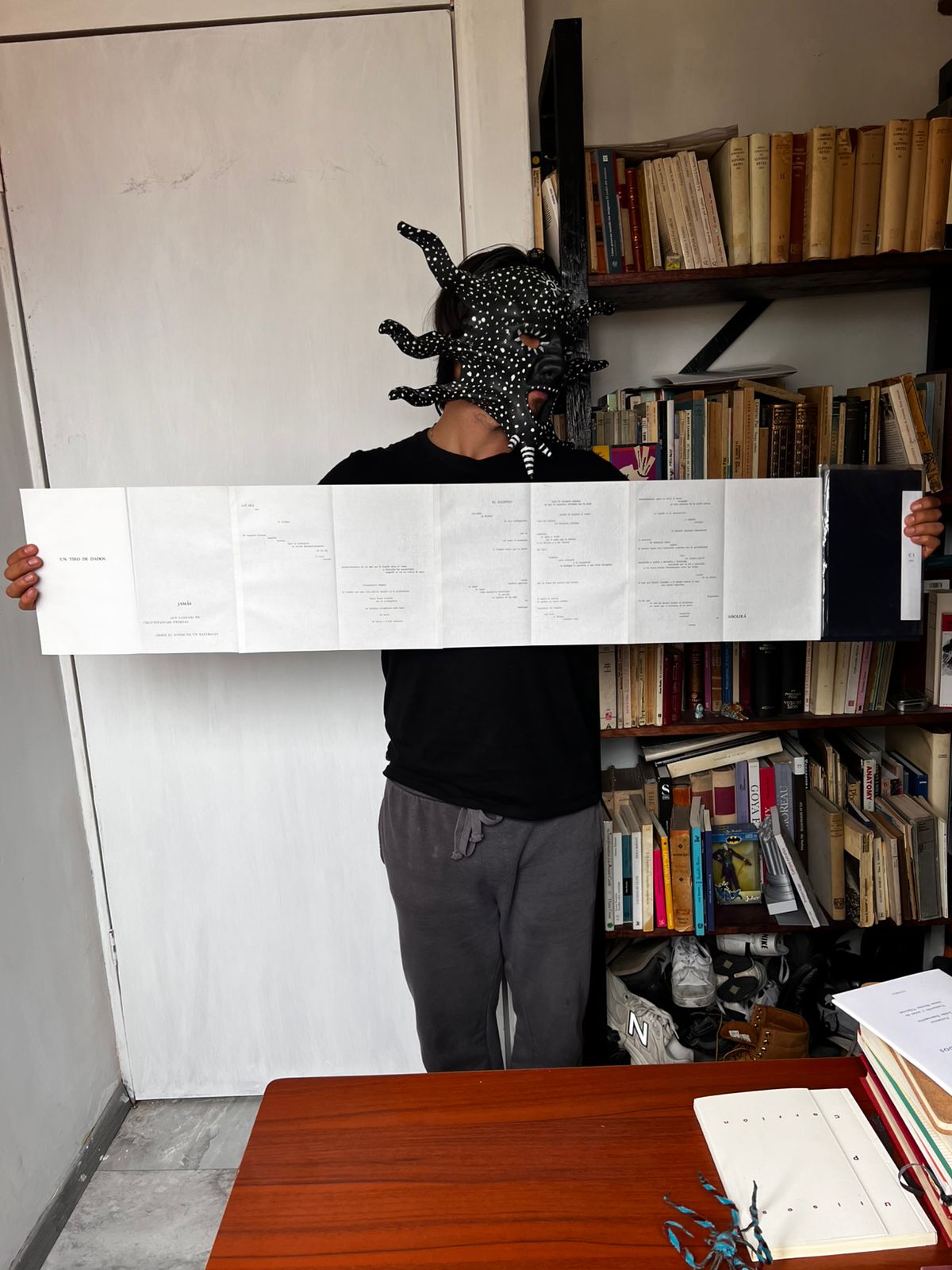
How did this place come about and what made it different from the start?
The grammar monkey emerged during the redesign of the Balderas corridor by the Mexico City government. Previously located on Enrico Martínez Avenue, during this new phase of the project, the collective was relocated to a spot across from Parque de la Ciudadela. As such, The grammar monkey has been around for over eight years in the virtual world. During the boom in online book sales, we entered the market with a selection of philosophy and literature books, but we also began introducing art books and specializing in the Mexican publishing tradition of the 1960s and 70s, which is rich in artistic and editorial design, and of course, in the content of its pages. Cataloging and showcasing this type of material began to establish us within the online world of book culture.

What part of the day, space, or creative process do those who work here enjoy the most?
Every day, managing the physical space is a challenge. You have to be ready to work with whatever material you find because, in the book world, it's a common belief that you'll never have the exact book a customer asks for. Our bookstore is more about letting yourself be captivated by the opportunity presented by the book that occupies a certain space. You could say that space is always a factor in this market. On the other hand, being located in the park means dealing with the challenges that entails, from idleness to cleanliness. Studying the book trade in the country, we realized that in many cases, the introduction of books seeks to dignify the space they occupy. The reality we face in Parque de la Ciudadela encourages us to respond with a curated selection that complements the vibe of the place: we try to offer books from different artistic movements, adhering to the avant-garde; we like photography books, and this fits perfectly with the location since we have the Centro de la Imagen (Center for Image) right next door. Every day we try to reinvent ourselves through the pages; the book gives you many possibilities.

If someone is coming in for the first time, what should they not miss?
We would advise you to pay close attention to every corner of the cabinet, as each book is there for a reason. For example, right now we have an area dedicated to books on color theory and painting techniques, which belonged to the painter José Zúñiga. A few months ago, we were able to purchase his library and found countless posters among the books, from hand-drawn sketches to signatures of other artists like Tamayo and Santos Balmori. One of the books that particularly caught our eye was one inscribed by the Italian sculptor Sciola, with whom Zúñiga corresponded. Books of that kind will be found on our shelves.

What has been an interesting challenge that has made you rethink something about the project?
On the one hand, there is unfair competition, but this is not new. If you pay attention to how literature has taken the book and commerce as one of its topics, the same things are always repeated: the fact that there is a greedy and quarrelsome bookseller or the theft of ideas. That has not really changed, and it is difficult to deal with people's scruples through a business that is all about sentimentality.
Within this world, if one is not constantly rethinking the way one conducts oneself, it is likely to be buried; in recent years, the closure of bookstores has become very common.

What influence, idea, or reference continues to shape the way you work today?
We could say that one of the guiding principles is the surprise of discovery. Having artistic aspirations, we are always seeking to renew our concepts, and the book has taken us through a world of vast forms. For example, I was previously completely ignorant of the world of sculpture, and thanks to the book, I have been able to delve into related topics. Thanks to the book, I became a fan of the book illustrators who emerged from the creation of the SEP (Mexican Ministry of Education) and the support Vasconcelos gave to the book. I'm referring to artists as prolific as those always mentioned in textbooks. The work of those who preferred covers and paper to walls—I'm referring to Francisco Díaz de León, Gabriel Fernández Ledesma, Roberto Montenegro, and others. This tradition of illustrators and book designers extends to figures of modernity, such as the recently deceased Vicente Rojo.

What place, project, or person has inspired you recently and why?
We've always been fans of the work of bookseller Max Ramos, head of the Jorge Cuesta bookstore. The way he works with books, so meticulously and with such passion, is a way of dignifying them, renewing the soul of old things. He's also a great connoisseur of literature, artistic avant-gardes, art books, and antique books.
I'm a big fan of publishers like Skira, Franco Maria Ricci, and Jean-Jacques Pauvert, all of whom are benefactors of culture through books. Skira founded the magazine Minotauro in France, where the first essays by the Surrealists appeared. Ricci is a great benefactor of culture in Italy, and thanks to him, the Library of Babel collection was created, from which Borges selected the titles that were most important in his life. Ricci also first printed works that broke with the mold of Roland Barthes's output, such as his study of Arcimboldo and another on fashion design in Paris with the arrival of Vogue magazine and the designs of Erté. Pauvert was simply the discoverer of Sade's works; from then on, book culture in France changed profoundly.
It seems that our destiny is to make a book from its content to its materiality.
If your space could invite someone to collaborate for a day, who would it be and what would you do together?
We would like to invite Abraham Cruz Villegas and propose that he create a thematic installation based on certain interests we share. He is a great connoisseur of Miguel Covarrubias's work and of publishing culture, and part of our mission is to promote this type of book.
Another great friend of our project is Cuauhtémoc Medina, who has one of the most beautiful and complete libraries on the topics that interest us. We are thinking of starting to conduct interviews to talk about important or rare books.

Is there an object, corner or detail of the place that has a story that few people know?
As we've been discussing, the physical location has its own peculiarities, and few people know that at night the book zone transforms into a hotbed of activity. La Ciudadela is a red-light district, much like all the parks and open spaces in the Cuauhtémoc borough, from Juárez to Guerrero; no place is exempt.
If this project were a city, a book, or a record, which would it be and why?
Right now we're really into Cocteau Twins' "Haven or Las Vegas"—we could easily transform into those melodies. We also listen to a lot of Lou Reed and Talking Heads; David Byrne has certainly sounded like a monkey on many occasions. One book that's a touchstone for us is "Solenoid" by Cartarescu, a Romanian poet and prose writer who draws inspiration from the book itself to create his story. When literature embodies the literary craft and the book itself as the object of its aspirations, we're dealing with a genre that rarely occurs in the history of literary art.
Answers by Mario Plenti, co-founder and in charge of curation and social media of El mono gramático.
