
What pieces or projects have you been working on lately?
I am currently studying a master’s degree in documentary photography at the London College of Communication. The reason I came here to study is that I was interested in developing a more political perspective in my work. The most recent series or essays I’ve been working on have been part of this program.
One of them focuses on a group of residents in Potters Bar, a town north of London that is separated from the English capital by what is known as the “Green Belt.” The Green Belt consists of agricultural land, forests, and protected green areas whose purpose, since its conception in the 1890s, has been to prevent the uncontrolled expansion of the city. In recent years, it has been criticized as a policy that limits housing construction and, as a result, drives up rental prices.
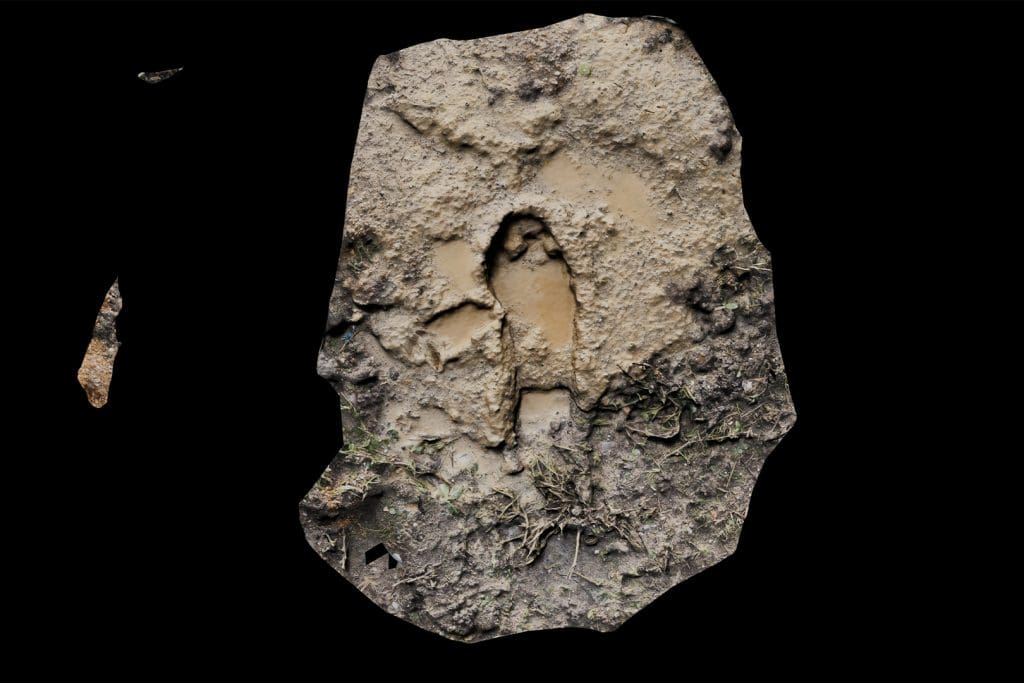
Today, residents of Potters Bar are organizing to oppose developments on agricultural land within the Green Belt that separates them from London, because they use it as if it were a park. There are several oak trees over 200 years old in the area, and wildlife such as deer, foxes, and badgers also pass through. However, what is planned to be built there is not housing, but a data center.
Since 2024, data centers have been classified as “critical infrastructure” by the UK government, leaving them almost entirely exempt from restrictions. The state is unable to see why this land is valuable to residents, because it cannot be argued to have high productive or even ecological value: it is not a biodiverse area, nor is it officially a park. However, the way the space is used has led residents to feel a strong attachment to it and, as they told me, a spiritual connection to the place. I titled the series, which was originally a video, A pilgrimage to a data center.

What did you learn (or unlearn) while working on this project?
It has been a process involving a great deal of research, both technical and thematic. I learned to use new tools such as photogrammetry and the software Blender in order to work with the results produced by photogrammetry.
I read the book Seeing Like a State, which discusses how a state shapes its territory and, to a large extent, the beings that inhabit it in order to make them legible and controllable. The idea behind this project, then, was to make visible what residents value and what the local government is unable to see.

Were there any conversations, movies, music, or books that made their way into that work?
In addition to the book I already mentioned, I would add another. I am a big fan of science fiction and speculative fiction, and a book I loved reading last year was The Word for World Is Forest, by Ursula K. Le Guin. I highly recommend it, but really I recommend reading Ursula in general, because so far I haven’t come across anything by her that I don’t love. She also has a very short essay called The Carrier Bag Theory of Fiction, which makes you rethink the entire way you look at the stories we consume.
What's been the most difficult thing you've faced recently in your creative process?
As I try to give my practice a more political character, or to develop works in which I actually have something to say, I’ve begun to realize that perhaps my ideas are not as clear as I thought. I find it difficult to explain what I want to do, or even to explain what I’ve already done once it’s finished.
I suppose that’s where the question lies of whether a piece is “successful” or not: whether it manages to communicate what I was trying to communicate, or whether others feel nothing when they look at it, or simply don’t understand it.

What is your favorite restaurant and what do you recommend we order?
If anyone is in London, I recommend Sonora Taqueria. Very expensive for tacos, but everything here is like that, and at least these are very good and make me feel closer to home. Order the taco caramelo.
In Mexico City, my favorite place is a Japanese restaurant that’s older than I am. It’s called Taro, it’s on Avenida Universidad. Highly recommended.

If your life were a movie this month, what would it be called and who would write the soundtrack?
This month had a road trip theme and a reunion with my father. So it would be something along those lines; I’m not sure I have a title. I’d like the soundtrack to be by Kiko Pinto, a musician who plays the charango and has a beautiful album called Haylli. My dad didn’t like his music at all.

Recommend us an artist you follow who inspires you, and tell us what you like most about their work or their way of working.
I recommend the work of Richard Mosse, such as Broken Spectre or The Castle. He certainly has critics, but I believe that, in terms of photography that is critical of its environment while also being capable of questioning itself through the very images it produces, there are few like him.
As contemporary photographers, I think we have to deeply interrogate our role in this image-world that has been forming for at least a century, but is now accelerating at what seems to be an unstoppable pace. Once again: data centers, artificial intelligence, environmental destruction. But also reflecting on why the camera and photography are so tightly bound to capital, to the forces that are destroying this planet. Every technological advance, every evolution of the imperialist model, is accompanied by a new use for photography or a new way of making it.
And here I circle back to Ursula, who has a great quote that goes: We live in capitalism, its power seems inescapable – but then, so did the divine right of kings.

Photographer and journalist from Mexico City interested in telling stories about socio-environmental conflicts, conservation, and regeneration. He currently lives in the United Kingdom.