How did this place come about and what made it different from the start?
For Georgina Pounds, the gallery began by listening to the city, the architecture, and the building’s previous life before defining an exhibition programme. Rather than imposing a model, the space itself shaped the vision.
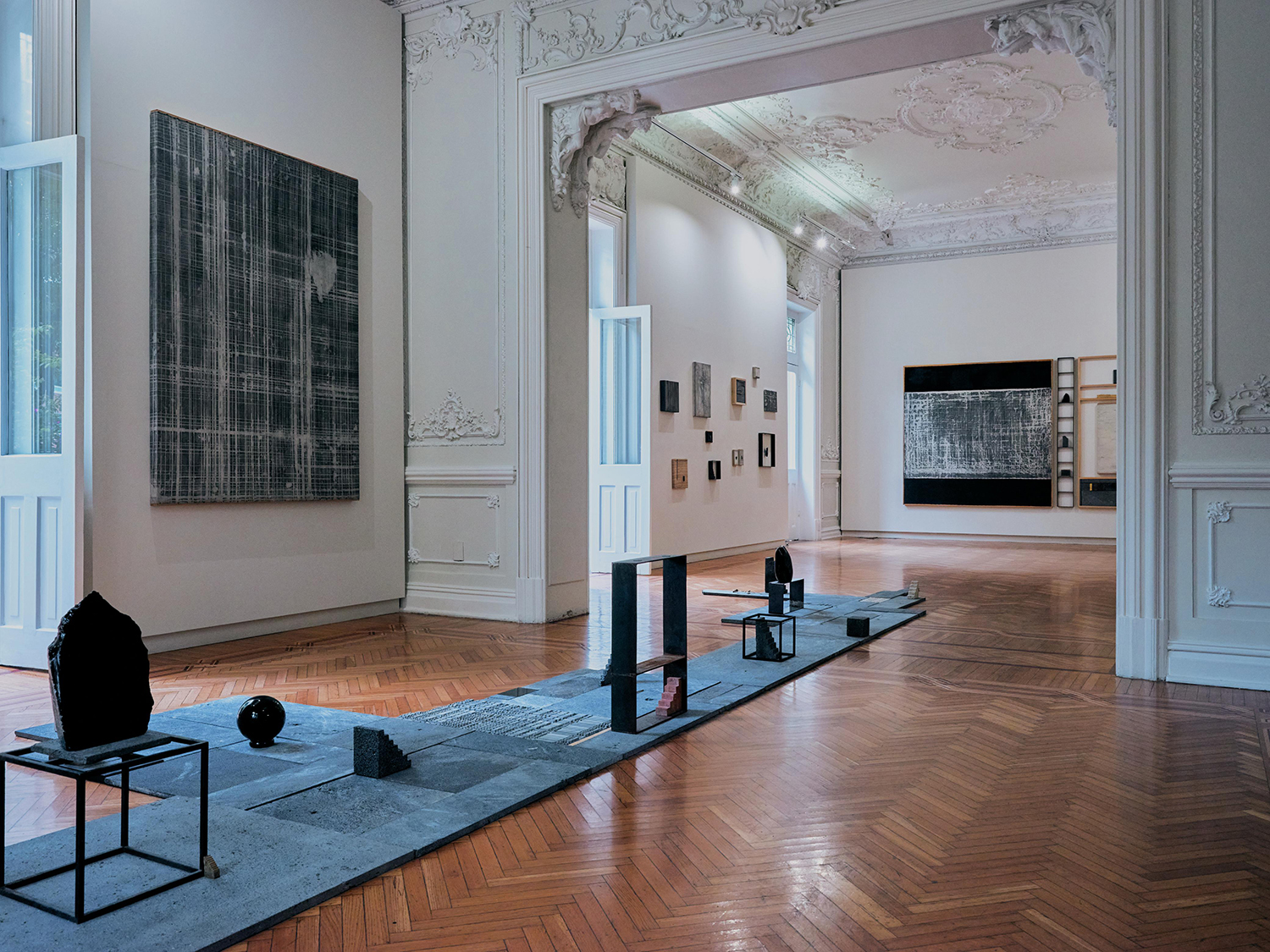
The rooms retain their historic names: Frida Kahlo, Nahui Ollin, Marguerite Yourcenar, and Luis Cernuda, preserving the memory of the artists once associated with the site.
Original 1911 features remain intact, including high ceilings, moulded details, and herringbone wooden floors.
The programme reflects Mexico as a place of history, imagination, and ritual. It brings together Mexican and international artists, whether established, mid-career, or emerging, whose practices engage with the country.
Artists such as Maria Kalach, Mónica Figueroa and Sofia Bassi feel inherently connected to the atmosphere of the space, where ancestral symbolism and everyday magic quietly coexist.

What part of the day, space, or creative process do those who work here enjoy the most?
Light plays a central role. The illumination shifts throughout the day, interacting with the baroque walls, while the nighttime lighting becomes theatrical.
The process of installing exhibitions, selecting works in dialogue with the architecture, and collaborating with curators such as Constantin Nakov is where the space truly comes alive.

If someone is coming in for the first time, what should they not miss?
Visitors are encouraged to spend time in the gallery: to read, write, or simply sit among the works.
Talks, readings, and intimate performances accompany the exhibitions, continuing the building’s legacy as a cultural meeting point.
Early programming included a talk by art historian Katy Hessel linked to her forthcoming book, marking her second visit to Mexico following The Story of Art Without Men in 2024. And Gemma Janes presented two artist books: The Debutante and Other Stories by Leonora Carrington, featuring a special cover by Tall Lennox, and Companions, with a cover by Jessica Luostarinen. Read one of these!

What has been an interesting challenge that has made you rethink something about the project?
The gallery was conceived as a collaborative model. Working closely with other galleries, including the Bassi Foundation, the archive of Kati Horna and JO-HS for the exhibition of Perla Krauze with Condo, has shaped a programme rooted in exchange rather than competition.
In a shifting art landscape, this approach feels like a more generous alternative to traditional gallery structures.

What influence, idea, or reference continues to shape the way you work today?
Architecture remains central. Opening a gallery in a 1911 building was a deliberate choice: to let memory and structure guide the programme.
Roma Norte itself embodies continuity and change, a neighbourhood where historical architecture adapts to contemporary rhythms.
The artists exhibited are those who find inspiration in Mexico’s layered realities: history, imagination, witchcraft, and everyday life.
The programme brings together Mexican and international artists connected to the city, including Sofia Bassi, Maria Kalach, Mónica Figueroa, and Kati Horna.

What place, project, or person has inspired you recently and why?
Casa Pedregal by Luis Barragán demonstrates how light and proportion shape emotional space.
The Museo Anahuacalli, built in volcanic rock, draws on pre-Hispanic cosmology and elemental symbolism.
The studio of Bosco Sodi and Casa Wabi Mexico City, designed by Alberto Kalach, reveal how architecture and materiality can respond directly to artistic practice.
Together, these spaces show how art and architecture deepen one another.

If your space could invite someone to collaborate for a day, who would it be and what would you do together?
Luis Barragán, to learn from his understanding of space and light. A gallery inside one of his buildings would completely transform the programme.
Or Edvard Munch, whose emotional intensity still resonates today. I’d like to meet him and understand the way he saw the world.

Is there an object, corner or detail of the place that has a story that few people know?
The doors are labelled with artists’ names: Frida Kahlo, Marguerite Yourcenar, and Luis Cernuda, each leaving a symbolic trace.
These references quietly haunt the space with artistic memory.
The women’s moulded faces on the ceilings remain a mystery that I hope to uncover one day.

If this project were a city, a book, or a record, which would it be and why?
Wieskirche, the Rococo church celebrated for its luminous white interior flooded with light.
Actually, that’s not a book or a city. Let’s say somewhere where the light feels supernatural.
Maybe Matisse’s chapel in the south of France. Although that’s not a city or a book either. Apparently, this place reminds me of a church.
Answers by Georgina Pounds, gallery owner.

A new gallery in Mexico City
Alvaro Obregón 99, Roma Norte
Mexico