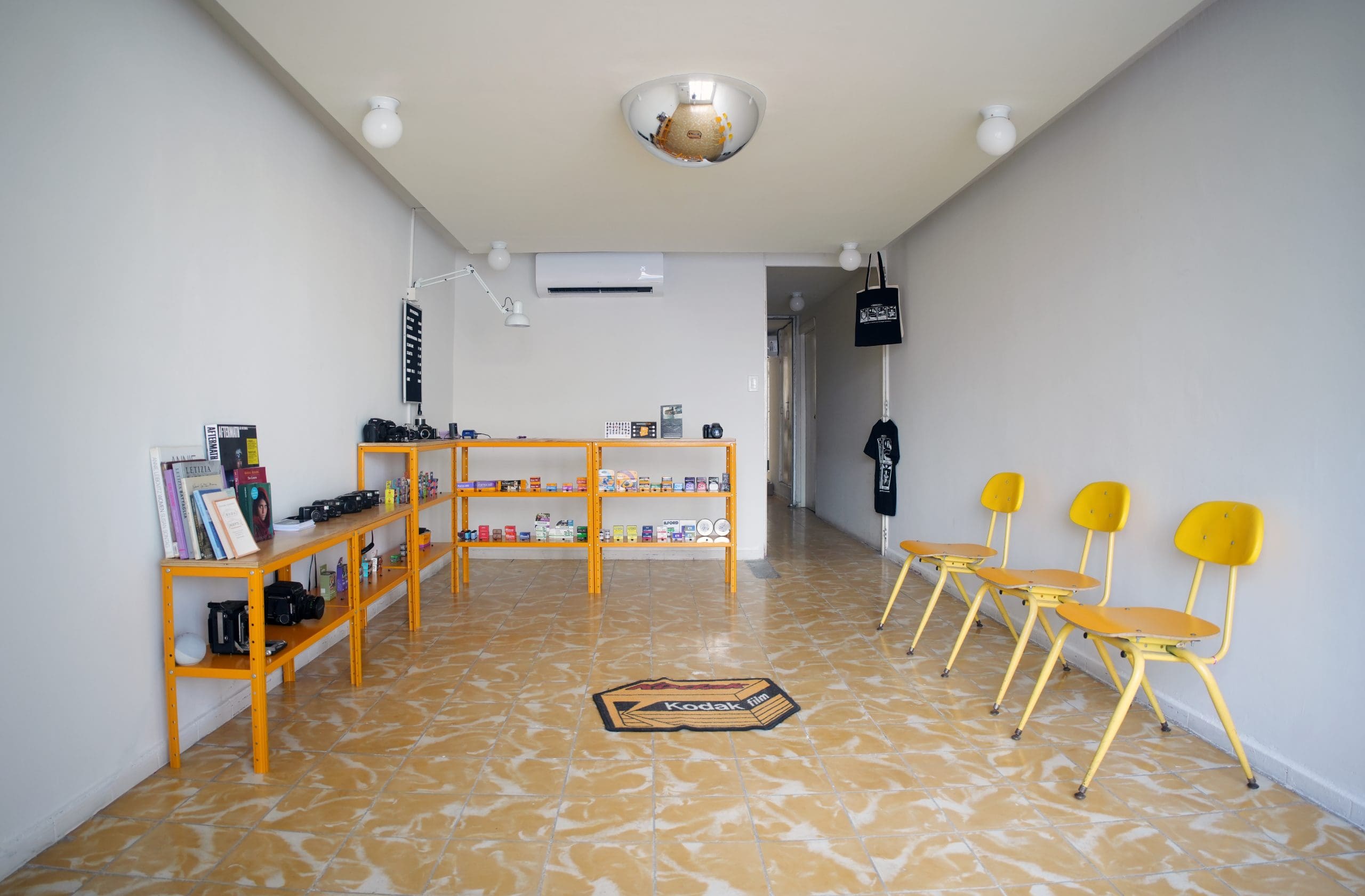
How did this place come about and what made it different from the start?
Fotograma Film Lab was born inspired by some of the best laboratories in the world such as Foto Hércules, Carmencita Film Lab, The Darkroom, The Find Lab, The Blackhole Lab, Lighthouse Film Lab, among many others. We were captivated by the way they work and how they represent film not only as a technical process, but as a way to preserve memory and strengthen the community around analog photography.
Before opening Fotograma, I was fortunate enough to learn firsthand by working in Bengala Film Lab, an experience I will always remember with great gratitude. I was also a client of all the labs in Monterrey, and I took away the best from each one. Added to this, since I was already doing the entire developing and scanning process myself, these lessons became the foundation upon which the idea for Fotograma was born: a space that gathers and honors the best of each reference to make it available to the community.


Furthermore, something very important to us from the beginning has been the camera culture, inspired by projects such as Tokyo Camera Style, where each camera tells a story and becomes part of the identity of the person using it. We understood that our role was not only to develop film, but to give value to the entire universe that surrounds film: the cameras, the processes, the community, and the experiences behind each photograph.
That's what made us different from the beginning: not just offering a service, but creating a space where every roll of film and every camera has a place, and where every person who arrives feels part of a living analog community.

What part of the day, space, or creative process do those who work here enjoy the most?
We agree that our favorite moment is scanning at the Frontier. It's there that the negatives are transformed into photographs with all their magic, color, and surprises, and where we feel most closely the emotion of those who trust us.
If someone is coming in for the first time, what should they not miss?
You definitely shouldn't miss the Club Fotograma. It's a space we created for our community, offering several benefits designed to support those who develop with us. More than just a program, it's a way to belong and feel part of the Fotograma analog family.

What has been an interesting challenge that has made you rethink something about the project?
One interesting challenge has been our turnaround times. From the beginning, we aimed for a regular three-business-day turnaround, making us the fastest lab in the north. Initially, maintaining that speed without sacrificing quality was a challenge, but that's precisely where the learning came in: optimizing processes, improving our team organization, and finding a balance between speed and excellence.
That challenge, far from stopping us, propelled us to grow. Today we understand that agility can also be a way to care for the community, because we know that the excitement of seeing your photos can't wait too long.


What influence, idea, or reference continues to shape the way you work today?
What continues to guide us today is the idea that analog photography is a community. Everything we learned from other labs and projects taught us one clear lesson: each roll of film is important, but even more important is the experience of the person behind the camera.
That's why we continue working with that same conviction: maintaining the quality of service, paying attention to detail, and at the same time fostering a cinematic culture and the camaraderie that develops around filmmaking. That blend of inspiration and community is what drives us every day.

What place, project, or person has inspired you recently and why?
We have recently been very inspired by the project of Nostos, who photograph weddings on film with a poetic and distinctive approach. We love how they manage to give such a sensitive and personal twist to a genre often thought of solely in documentary terms. These kinds of projects remind us that analog photography still has new avenues to explore and that there are always creative ways to tell stories with film.
If your space could invite someone to collaborate for a day, who would it be and what would you do together?
If our space could invite someone to collaborate for a day, it would be Gabriel Moises Rivera. We would love to organize a documentary photography and printmaking workshop with him, because his perspective and way of telling stories through the camera have so much to offer the community. It would be the ideal combination: learning from his experience and, at the same time, using the darkroom as a meeting point to create and reflect on what it means to photograph everyday life.

Is there an object, corner or detail of the place that has a story that few people know?
One little-known fact is that much of the equipment we use comes from laboratories that no longer exist, both in Mexico and in the United States and South Korea. Each machine has its own story, and in a way, it lives on here at Fotograma. We like to think that we not only develop film, but also continue a tradition that could have been lost.
If this project were a city, a book, or a record, which would it be and why?
It would be Endtroducing….. by DJ Shadow. We identify with it because, just as the record is made entirely of samples, analog photography is also constructed from fragments: of light, of memory, and of equipment that has passed through other hands before reaching us. This mix of stories and objects that are recycled and given new meaning is precisely what gives each roll of film a unique vibe.
Answers by Oziel Treviño, founder of Fotograma Film Lab

Analog photographic laboratory
Alvaro Obregón Norte 110, Centro
Monterrey, Nuevo Leon, Mexico