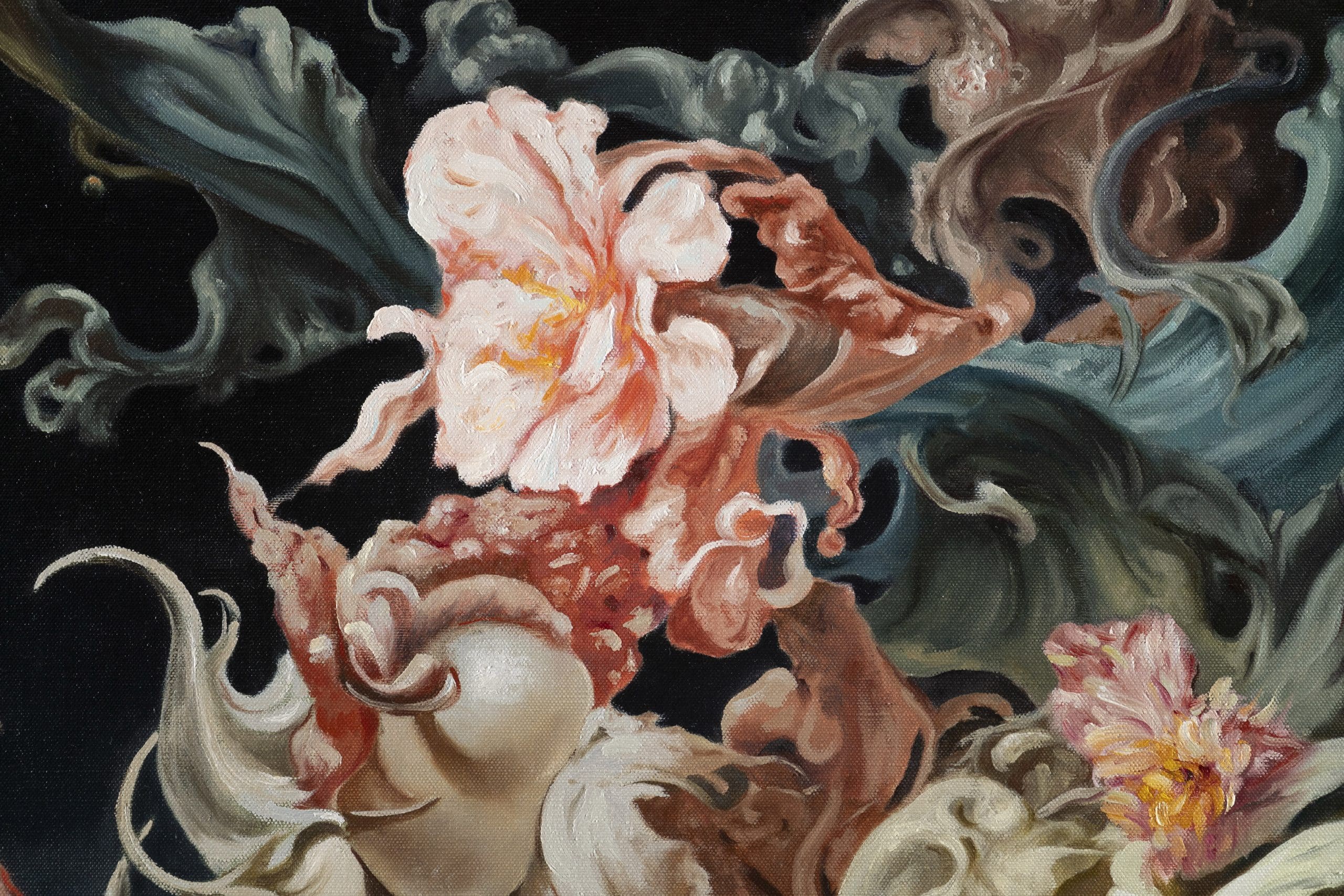
What pieces or projects have you been working on lately?
I’ve been immersed in Afantasía: a series that began when the screen gave me a clean, impersonal “no”; a faceless rejection that, paradoxically, ended up shaping the project itself. From that first blockage, I understood that images have always been managed, by myth, decorum, museums, the market; what changes today is the nature of control: an automated and ubiquitous customs office embedded in the very act of producing and circulating images, capable of operating in real time and at massive scale.
Painting appeared as a way of translating that algorithmic censorship into matter: subjecting an image to iteration, searching for the “permissible” version, and then giving it weight again, as if pigment could retain the trace of that chain of permissions and omissions.
The backbone of the project has been the Still Morte series (I–IV) and its studies: scenes where the limit does not erase desire, but displaces it. I’m interested in that displacement because it has its own visual logic: where there should be skin, foam, folds, or light appear instead; where the archetype promises a body, the platform demands substitutes. I’m not “illustrating” generated images; I’m documenting the edge where the machine can no longer speak, and where painting insists as a slow technology, as a site of friction.

What did you learn (or unlearn) while working on them?
I learned to iterate, though not in the sense of searching for “variations”: to iterate as one listens. Every refusal carries information about the moral regime of the image: what is considered a violation, what is tolerated, what becomes invisible without ever being declared so. It’s a silent pedagogy; algorithmic censorship does not punish through scandal, it educates through habit. And in that training, almost without noticing, part of oneself begins to self-correct before even formulating the image.
More than the idea of a “free image,” what I unlearned was the fantasy of an image without tolls: an image that doesn’t have to pass through mediation. If before we negotiated with canons, institutions, or audiences, now we also negotiate with platform policies and their rules of acceptability. In Afantasía that negotiation stops being merely conceptual and becomes form itself. I also unlearned a certain anxiety around “showing everything”: here, ellipsis stops being loss and becomes method. In the end, painting forced me to hold an uncomfortable but fertile position: slowness is not romanticism, it’s a work ethic; a way of demanding from the eye the time the feed steals from it.

What words, ideas or emotions were going through your head?
Permission, customs office, visual regime, substitute. I became obsessed with the idea that desire itself is administered: not only by inherited morality, but by platform policies, filters, metrics, and economies of attention. What dominates works best when it doesn’t need to name itself; meanwhile, anything outside the script always carries an adjective, a warning, a label. And the body, especially the desiring body, becomes trapped within that imbalance: appearing as excess, as a technical problem, as something that must be moderated.
Emotionally, there was a strange mixture: a hunger for friction and, at the same time, a kind of lucidity. Hunger for materiality, for a time that cannot be reduced to “updates.” And lucidity because the project gradually revealed something simple: censorship does not only limit what is visible, it also organizes what can be imagined. Against that, painting became a form of insistence.

Were there any conversations, movies, music, or books that made their way into that work?
Istanbul, by Orhan Pamuk, slipped into the project as a way of reading the city and the mood: layers, fog, memory. I arrived at Pamuk through a path I owe to Humberto Chávez Mayol: his way of thinking about melancholy not as sadness, but as method, an ethics of attention, a way of standing at the level of what is lost and still continuing to look. That sensitivity mattered because Afantasía is also, at its core, about a loss: the loss of the mental image when imagination becomes externalized.
Un mundo perseguido, by Juan Vicente Aliaga, appeared as a reminder that visibility, whenever it brushes against desire, always carries a history of permissions, persecutions, and silences. And Bugonia, by Yorgos Lanthimos, a remake of Jang Joon-Hwan’s South Korean film Save the Green Planet! (2003), functioned as a contemporary mirror: paranoia, corporations, and that feeling that the world no longer fully distinguishes between reality and its interfaces. It’s not that the project “quotes” these references; rather, it lets their temperature seep through.

What's been the most difficult thing you've faced recently in your creative process?
Time, always, and the voracity of the city. The city pushes you to produce, to respond, to stay available, as if the work had to justify itself through speed. This project demands the opposite: sustaining doubt, not resolving things too quickly, letting the image struggle against its own limit before becoming public. The difficult part has been protecting the rhythm of the studio as if it were a scarce resource: defending slowness without turning it into a pose.

What's your favourite restaurant and why do you like going there?
Los Sirenos, at Mercado de San Juan. Octopus tacos, without hesitation. And if they have it, the charcoal-grilled catch of the day.

If your life were a movie this month, what would it be called and who would write the soundtrack?
When it comes to films and soundtracks, it’s impossible not to think of my dear Ricardo Milla. Recently, while walking through the halls of Zona Maco, he shared a Julia Cameron quote with me that stayed like a secret subtitle: “Art is a spiritual transaction.” And yes, sometimes this week feels as if it were directed by Rubén Östlund, with that mixture of uncomfortable comedy and social choreography. If I had to give it a title, it would be: Retinal Regimes. The soundtrack would be hybrid: Philip Glass for the loops, that systemic pulse, and Yussef Dayes for the body that insists and slips outside the script.

Which studios, laboratories, or workshops have you collaborated with recently or would you like to collaborate with in the future?
I’ve been close to Estudio RN, with Rodrigo Navarro, my accomplice in color and in those decisions that seem technical but end up being emotional. Also with Alexis Gutiérrez, at Laboratorio de Impresión,, a lifesaver whenever I need to think through translations of the image without betraying the material. And with Pictórica Taller, for those inevitable questions around conservation.

Recommend one or more artists you follow who inspire you, and tell us what you like most about their work or their way of working.
Lately, I’ve realized that I follow certain artists the way one returns to a conversation: not to confirm ideas, but to ask new questions. In Guadalupe Quezada I’m interested in that ability to bend what feels stable: her pieces shift your perspective as if “reality” were, in the end, a fragile agreement. Chicome Itzcuintli Amatlapalli accompanies me through another route: a fertile tension between tradition and wound, memory and spirituality without folklore, as if the baroque could be rewritten from a different center.
I’m also inspired by practices where method becomes character. I like Jeff Iorillo because his abstraction is not decoration: it’s a laboratory, an ethics of process where the material takes command. Carlos Rittner attracts me through the way he works with signs and light: he makes an archive contemporary without sealing it shut, as if luminosity were a bridge rather than an effect. In Roberto Tostado there’s nerve and atmosphere: figures that feel both close and strange at once, an emotional register that resists closure.
And there are artists who interest me because of their attention to meaning, to that zone where the work stops “representing” and begins insisting. I’m drawn to Sung-Hee Son because of that double edge between practice and curatorship: her work thinks through the meaning of things, not their appearance. Vanessa Zárate intrigues me when time becomes matter, when landscape feels like deep memory rather than scenery. Paula Benard teaches me how to sustain sensitive atmospheres without sentimentalism: emotion through resistance, not excess. And David Serrano attracts me because of the way he tensions the everyday: a slightly twisted light that gives the day a second reading.

Visual artist and cultural manager based in Mexico City. His work crosses painting, performance, and archival practices to reflect on the body, intimacy, and representation in the post-internet era.