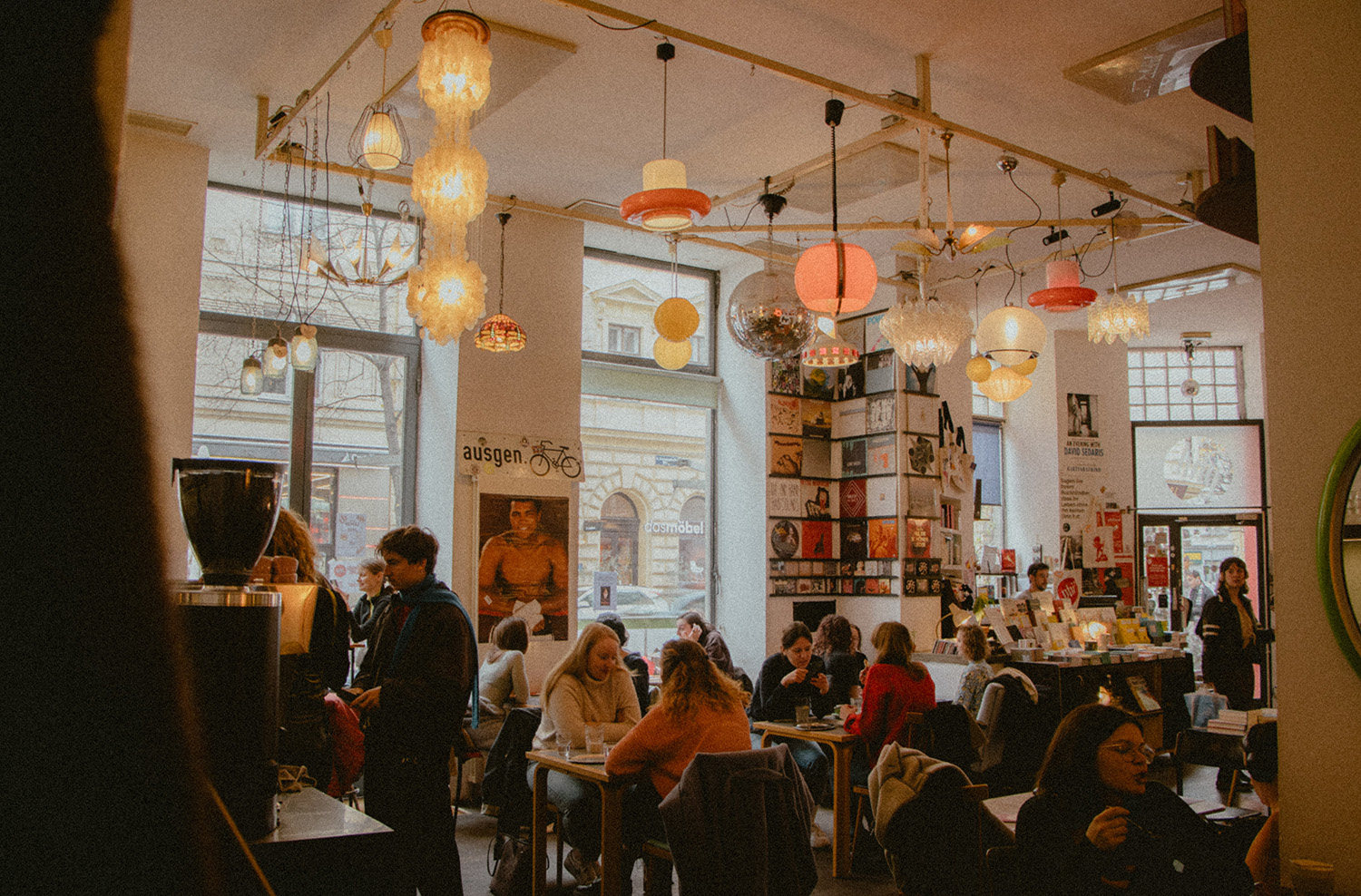
How did this place come about and what made it different from the start?
The original idea goes back to the previous owner, who stumbled upon a similar model in Asia over 20 years ago: a café that is also a bookshop, filled with vintage design. Over the years, it grew into a kind of extended living room for the neighbourhood, combining the charm of a classic Viennese coffeehouse with the world of books. I took over in February 2025. What makes it different is that nothing here follows a master plan. The interior, the walls, the posters, and the more than 4,000 books used as decoration all grew organically over two decades. We call it “curated disorder”, and it is the deliberate opposite of a polished, over-designed café.

What part of the day, space, or creative process do those who work here enjoy the most?
The way the place transforms over the course of a day. In the morning, we are a bright breakfast spot with a lovely Schanigarten outside; as the light shifts, we slowly turn into a bar. Espresso becomes espresso martini, a matcha latte becomes a glass of wine. Watching that slow change, and shifting roles along with it, is what the team enjoys most. On the other end, there is the full Saturday rush, when the lines between roles blur: a bookseller might jump in to wash dishes while everyone in service also knows exactly how to sell a book.

If someone is coming in for the first time, what should they not miss?
Start with the coffee. We now roast our own house blend, dark and velvety, and in summer the cold brew is worth trying too. But the real thing to do is take your time and look around. The more than 4,000 books are not just decoration, they are for sale, so pull something off a shelf you were not looking for. Notice the vintage furniture, the records on the walls, the ceiling full of lamps that grew over the years. Half the experience is simply wandering and discovering something unexpected.

What has been an interesting challenge that has made you rethink something about the project?
The hybrid model itself. A bookshop wants people to linger and browse for hours; a café needs tables to turn over to stay profitable. Both compete for the same space and the same time. It forced me to rethink what “success” means here. Instead of pushing for faster turnover, the challenge became finding a balance where calm and lingering are exactly the point, while the place still works as a business.

What influence, idea, or reference continues to shape the way you work today?
The idea of the “extended living room”. Everything comes back to that: a space where a guest should feel they can escape the city for a while, read, meet someone, or just sit with a coffee without pressure. In a moment when new cafés open constantly, good coffee alone is not enough anymore. You have to offer an experience worth returning to, and the living-room idea is the compass for every decision.

What place, project, or person has inspired you recently and why?
A book: The Art of Creative Thinking by Rod Judkins. Its core idea is that nothing is ever finished, that you cannot rest on what already works, and that the most interesting things come from constantly questioning and rethinking. That mindset shapes how we run phil: we try to give our guests a new experience every time, not the same thing twice. There is also a deeper Viennese connection here. The classic coffeehouses were never just places to drink coffee; they were where writers, painters, and thinkers spent their days, argued, exchanged ideas, and influenced each other. That culture of exchange, of a café as a place where things actually happen, is exactly what we want to keep alive: a space that is never standing still.

If your space could invite someone to collaborate for a day, who would it be and what would you do together?
T.C. Boyle, for a reading and a long conversation in the room downstairs, or, if we could bring anyone back, J.R.R. Tolkien, surrounded by our 4,000 books. We are currently building our roughly 200 m² basement into a space for workshops, seminars, and events, and having an author like that inaugurate it would be the dream first event: exactly the kind of moment that shows what that space can become.

Is there an object, corner, or detail of the place that has a story that few people know?
Outside, by the entrance, there is a small blackboard. On it, in his own handwriting, the Austrian Federal President Alexander Van der Bellen once wrote the words “Mut zur Gelassenheit” — courage to stay calm. Most guests walk past it without realizing whose hand wrote it.
Inside, there is the ceiling of lamps: it was not planned, it grew over the years, one lamp at a time, until it became this dense, glowing canopy that everyone photographs without knowing it was never designed. The same applies to the records on the walls. None of it was a decorating decision; it simply accumulated, and that is exactly why it feels real.

If this project were a city, a book, or a record, which would it be and why?
Wanda – Amore. It is a Viennese record through and through: a mix of warmth, humour, and melancholy, bright and easygoing one moment, dark and a little wistful the next. That is phil over the course of a day. The lively breakfast morning is one side; the slow transition into espresso martinis and wine in the evening is the other. Same record, two moods, and you need both to understand the whole thing. Very Vienna, a little crackle included.
Answers by Jonathan Zilberberg, Owner & Managing Director, Café phil (Lewi & Son GmbH).
cafephil.at
